


How Long Does PVD Gold Plating Last? The Honest Answer

PVD gold plating lasts 2 to 5 years on a piece worn every single day, and 8 to 10 years on one worn a few times a week. That spread is not marketing vagueness. It comes down to three things: what sits under the coating, how the gold was bonded to it, and where the piece rubs.
PVD is not plating, and that difference is the whole answer
Traditional gold plating is an electroplated layer sitting on a base metal. Functionally, a coat of paint. A shopper on r/jewelry put the distinction better than most brand pages do: "Plating is just an outer layer that can flake off, but PVD coating is a process that changes the color of the stainless steel."
PVD stands for physical vapor deposition. Gold is vaporized in a vacuum chamber and driven into the base metal at an atomic level. At VM that bond is built over 72 hours of controlled heat. The result is not a layer waiting for an edge to catch it. It is fused into the metal.
The base underneath matters as much as the bond. VM builds on a hypoallergenic surgical steel base, and steel does not corrode from below. That is the failure mode that ruins cheap plated brass: the base oxidizes, pushes up through the gold, and the piece discolors before the gold has worn away. The same thread named it as the reason to buy steel at all: "Stainless steel is waterproof, doesn't turn your skin, and it's very affordable."
There is a second problem with the word "plated." As one commenter pointed out, "there's no regulation on how much gold needs to be on the item for it to be called gold plated." Two necklaces can carry the identical label and differ tenfold in how long they hold color.
The real wear timeline, by piece type
Wear is a function of friction, not calendar time. A ring absorbs more abrasion in a month than a necklace does in a year, which is why a single number for "PVD jewelry" is useless. Here is what to expect from a properly bonded piece on a steel base.
| Piece type | Worn daily | Worn 2 to 3 times a week | First point to show wear |
|---|---|---|---|
| Earrings and studs | 10 years or more | Effectively indefinite | The post and the butterfly back |
| Necklaces and pendants | 8 to 10 years | 10 years or more | The clasp, then the section at the collarbone |
| Link and chain bracelets | 4 to 6 years | 8 to 10 years | The clasp and the underside that drags on desks |
| Stone-set and tennis bracelets | 4 to 6 years | 8 years or more | The box clasp edge and the setting shoulders |
| Rings | 2 to 3 years | 5 to 6 years | The inside of the band, then the outer edges |
Rings sit lowest. That is physics, not a VM problem, and any brand quoting a flat ten years across every category is quoting a brochure.
Where the color goes first
Gold does not fade evenly. It leaves from contact points, in a predictable order.
- Clasps and closures. On many brands the clasp is bought in from a different supplier than the chain, so it ages at its own rate. Shoppers blame the chain when the clasp is the culprit.
- Inner surfaces. The inside of a ring band and the back of a pendant sit against skin under pressure. They go before anything visible does.
- Outer edges and corners. Wherever the geometry comes to a point, the coating is thinnest and the pressure highest.
- Stack contact zones. Two bracelets worn together polish each other. Rotate a stack occasionally so the same two pieces are not always rubbing the same two spots.
The honest limitation: rings are the hard case
Here is the part most brand blogs skip. A ring sits on the part of your body that touches everything: keyboards, steering wheels, gym equipment, soap. Another r/jewelry commenter had it exactly right: "the inside of the ring is usually the first place to wear off."
A PVD ring on steel holds color far longer than plated brass, because there is no reactive metal underneath to turn your finger. But two to three years of hard daily wear is the honest expectation, not ten. Want a piece that looks identical in a decade? Buy earrings or a necklace. That is why VM prices the Elegance Deluxe Ring at $19.95 rather than pretending a ring is a lifetime object.

What actually shortens a PVD bond
The generic care advice you have read a hundred times was written for plated brass. One commenter gave the standard rule: "You have to be ok with taking off your jewelry for showers, swimming, washing dishes etc." Correct for plated jewelry. Wrong for waterproof PVD on steel.
What genuinely damages the bond:
- Chlorine and bleach. Pool water and household cleaners attack the coating chemically, not mechanically. The biggest avoidable factor.
- Abrasive polishes and cloths. Anything designed to remove a layer removes this one. Warm water, mild soap, soft cloth is the entire routine.
- Direct spray contact. Perfume and sunscreen sprayed onto a piece rather than skin leaves residue that holds moisture and grit against the surface.
What does not shorten it: showering, sweat, the sea, hand washing, rain, or sleeping in your jewelry. VM pieces are waterproof and tarnish-resistant, and the point is that you stop managing jewelry around your day. Longer version in our guide to gold bracelets that do not tarnish.
Three pieces, and what to expect from each
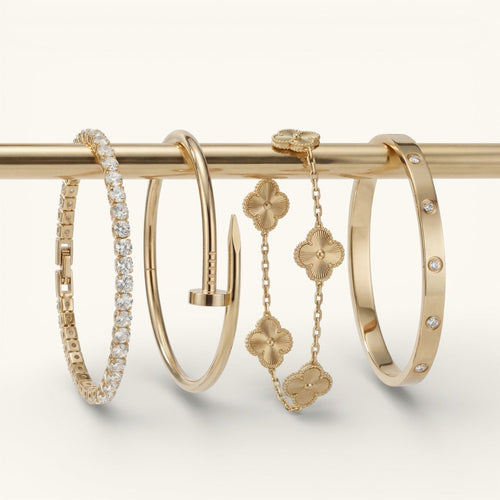
Elegance Deluxe Stack at $49.95 is the multi-piece option, so it is where the rotation advice matters most. Worn a few times a week it holds color for the better part of a decade. Worn daily as a fixed stack, the contact points between pieces soften first, around the four to six year mark.

Eternity Link Bracelet at $24.95 is the daily driver case. The clasp and the underside carry the friction. Four to six years of everyday wear is realistic, and the VM Triple Seal Coating is there to slow the clasp down, since that is the part that ages first.

And the Elegance Deluxe Ring above, at $19.95, is the short-timeline piece: two to three years of hard daily wear, priced so that is a fair trade. See the full range in the VM bestsellers collection.
Skeptical? Good.
You should be. This category is full of brands quoting durability numbers with nothing behind them. Assume the number is invented until someone shows you the mechanism.
So, the fine print. The 72 hour controlled heat bond and the surgical steel base are the mechanism, and the table above is what it buys you. Rings are the weak point and we said so. Clasps age faster than chains and we said that too. Nothing here claims a PVD piece is solid gold, because it is not.
What backs it: every VM piece carries a lifetime warranty, so an early bond failure is our problem and not yours. Customer feedback sits at 4.8 out of 5 on Trustpilot. And to test the construction across more than one piece, add any two bestsellers and the lower-priced piece is free at checkout.
Questions people actually ask
Does PVD gold plating wear off?
Yes, eventually. Every surface treatment does. The difference is the timeline and the failure mode: a well-bonded PVD piece on steel softens gradually at contact points over years, rather than flaking off in patches and exposing a reactive base metal underneath.
Will PVD jewelry turn my skin green?
Not on a surgical steel base. Green skin comes from copper and brass reacting with sweat once the coating above them is breached. Steel has no reactive copper content, so even at the points where the coating has thinned, there is nothing there to stain you.
Can I shower and swim in PVD gold jewelry?
Showering, sweating, rain, and the sea are all fine on VM pieces, which are waterproof by construction. Chlorinated pools are the exception worth taking seriously, because chlorine attacks the coating chemically rather than by abrasion. Rinse with fresh water afterwards if you forget.
Is thicker PVD always better?
Thickness helps, but the base metal decides more. A thick coating over brass still fails from underneath as the brass oxidizes and lifts it. A moderate coating fused into surgical steel has nothing beneath it that wants to react, which is why steel-based pieces outlast thicker-coated brass ones.
Which piece type lasts longest?
Earrings, by a wide margin, followed by necklaces. Both sit against skin with almost no abrasion. Rings come last for the same reason they always do: your hands touch everything, all day, every day. Bracelets sit in between, which makes them the fairest test of a brand's construction.
The verdict
PVD gold plating lasts two to five years on daily-wear pieces and eight to ten years or longer on pieces worn a few times a week, provided two conditions are met: the gold is vapor-bonded rather than electroplated, and the metal underneath is steel rather than brass. Miss either and the range collapses to months.
To test that construction, start with a bracelet rather than a ring. It sits mid-table and tells you the most about the build. Browse the bestsellers, or if sensitive skin is part of why you are reading this, our hypoallergenic picks go deeper on base metals.
Valerie Mason founded VM after years of replacing jewelry that discolored within weeks. She built the brand around vapor-bonded gold on surgical steel so everyday jewelry could survive an everyday life, and she still wears every new piece daily for a full season before it goes on sale.
Buy one get one free on all bestsellers
- Waterproof 18k PVD gold
- Hypoallergenic surgical steel
- Lifetime warranty
Backed by the lifetime warranty. Nothing to lose.
Why regular gold plating is outdated
| VM | Others | |
|---|---|---|
| Waterproof, wear it in the shower | ✓ | ✗ |
| Hypoallergenic surgical steel base | ✓ | ✗ |
| Gold bonded by PVD, not layered on top | ✓ | ✗ |
| Lifetime warranty included | ✓ | ✗ |
| Every piece under $60 | ✓ | ✗ |
Ready to never overpay again?
- ✓ Buy one get one free on bestsellers
- ✓ Rated 4.8/5 by 3,000+ customers
- ✓ Lifetime warranty. No questions asked.
Lifetime warranty. No questions asked.
If a piece ever fails you, we replace it. That is the whole policy.
As seen in Vogue, Elle, Cosmopolitan, Harper's Bazaar and NYT Style