


Gold Plated vs Gold Filled vs Vermeil vs PVD: What Lasts
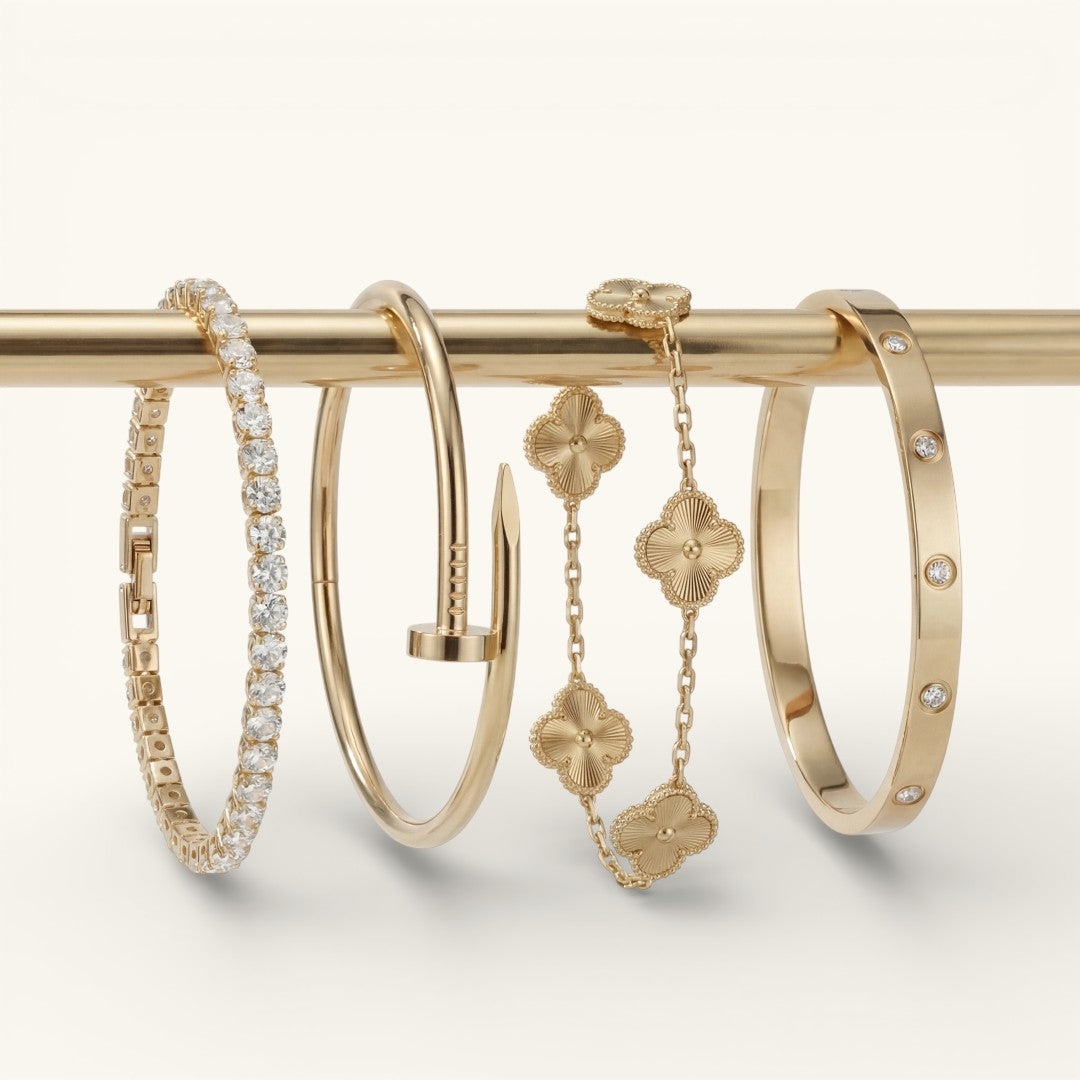
Short version: gold filled holds the most gold, vermeil puts real gold over a precious base, PVD has the strongest bond of the four, and gold plated has the least of everything. If you shower, sweat and sleep in your jewelry, PVD over surgical steel is built for that. If you keep jewelry dry and take it off at night, gold filled outlasts them all.
Four words get printed on product pages as if they mean roughly the same thing. They do not. One is a legal standard with a minimum gold weight, one is a legal standard with a minimum thickness, one is a manufacturing process, and one is basically unregulated, which is why so much of it looks green after a month.
The four types, side by side
| Type | What is underneath | Gold layer | Realistic daily wear | Water and sweat |
|---|---|---|---|---|
| Gold plated | Brass or copper | Often around 0.05 microns | Weeks to a few months | No |
| Gold vermeil | Sterling silver | 2.5 microns minimum by US standard | 1 to 3 years, kept dry | Not really |
| Gold filled | Brass core | At least 5 percent of total weight, bonded under heat and pressure | 5 to 20 years, kept dry | Tolerates it, does not love it |
| PVD over surgical steel | 316L surgical steel | Thin, but bonded into the surface rather than sitting on it | 2 to 5 years including wet wear | Yes |
Gold plated: the one that fails first
Gold plating is a thin layer of gold dropped onto brass or copper in an electroplating bath, averaging around 0.05 microns. There is no legal minimum in the US for how much gold has to be there before a brand can write "gold plated" on the tag, which is the whole problem.
Shoppers in jewelry forums describe the same arc over and over. The piece looks perfect for a few weeks, the high points go dull, the brass shows through at the clasp, the finger turns green. One buyer summed the category up after a bad order: "it's just gold covered brass." Plated is fine for trying a trend cheaply and accepting that it is disposable.
Gold vermeil: real silver under real gold
Vermeil is plating with a defined standard behind it. To be sold as vermeil in the US the base has to be sterling silver and the gold layer at least 2.5 microns, roughly fifty times the gold of cheap plating, over a base that is itself a precious metal.
The real benefit shows up when the gold wears. On plated brass, wear exposes brass, and brass reacts with skin. On vermeil, wear exposes silver, so the piece drifts toward silver instead of toward green. As one shopper who works in the trade put it, with vermeil you know you are buying something legally silver and legally gold, no tricks.
The catch is water. Sterling tarnishes on its own, and the gold over it is still a layer. Vermeil is a dry-wear metal.
Gold filled: the most gold per dollar
Gold filled is not plating at all. A sheet of karat gold is mechanically bonded to a brass core under heat and pressure, and US rules require the gold to be at least 5 percent of total weight, hundreds of times the gold in a plated piece.
It shows. Jewelers say gold filled outlives plating by a decade or more, and buyers report pieces still looking right after four or five years. If you want one piece that gets handed down, this is the honest answer at this price tier. Two caveats: the core is still brass, and you will pay several times the plated price for the same design.
PVD: a bond, not a coating
PVD stands for physical vapor deposition. The piece goes into a vacuum chamber, the gold material is vaporized, and it deposits atom by atom into the surface of the base metal. VM runs that process over 72 hours of controlled heat, then finishes with VM Triple Seal Coating.
The difference that matters is not thickness, it is adhesion. Electroplating leaves gold sitting on top of the base metal, held by a bond that water and sweat work loose from the edges in. PVD drives the material into the surface, so there is no film to lift. That is why PVD pieces are waterproof and tarnish-resistant while a plated piece of the same thickness is neither.
The base metal matters just as much. VM builds on 316L surgical steel, the same hypoallergenic surgical steel base used for piercing jewelry. No brass in the piece means nothing to expose that turns skin green. The full wear timeline by piece type is in how long PVD gold plating actually lasts.
Which one should you actually buy
Match the metal to your habits, not to the nicest word on the tag.
- You never take it off. Buy PVD over surgical steel. Nothing else here is designed to be worn wet every day.
- You take pieces off at night. Gold filled gives you the longest life and the most gold per dollar.
- You react to almost everything. Vermeil or PVD. Both keep brass off your skin, and our picks for sensitive skin go further on that.
- You want to test a trend for one season. Plated is fine. Just do not expect it back next summer.
The cost per year nobody runs
Sticker price is the wrong number. Cost per year of wear is the right one. A $30 plated bracelet replaced every eight months runs about $45 a year. A $130 vermeil piece kept dry for three years runs about $43. A $150 gold filled bracelet that lasts a decade runs $15. A $29.95 VM bracelet worn every day for three years, shower included, runs about $10. The gap is not about metal. It is about how many pieces you buy twice.
Where PVD loses
Two honest limitations, because you will find them out anyway.
First, PVD over steel has no precious metal content. No silver core, no gold weight, no melt value, no resale. If you want an object that is worth something on its own, gold filled or vermeil is your category. VM pieces are built to be worn, not sold on.
Second, PVD cannot be refinished. A vermeil piece can be replated when the gold thins. A PVD piece cannot, because the material is in the surface rather than on it. That is the tradeoff for it not lifting in the first place, and VM replaces a failed finish rather than repairing it.
What VM uses, and what it costs
Every VM piece is PVD over 316L surgical steel, sealed, and priced so the metal is not the reason you hesitate. Three bestsellers people start with:
Elegance Deluxe Stack

$49.95. Four coordinated bracelets in one buy, the fastest way to see how the finish holds across different link widths. See the Elegance Deluxe Stack.
Set Trio Sunkissed

$44.95. Three pieces that read warmer than the Deluxe stack, better if your wardrobe leans neutral. Same base metal, same coating, same behavior in water. See the Set Trio Sunkissed.
Helene Elegant Bracelet

$29.95. The single-piece entry point, and the cheapest honest way to find out whether a gold finish survives your routine. See the Helene Elegant Bracelet.
The rest sits in bestsellers, and this roundup goes deeper on individual bracelets.
Skeptical? Good.
You should be. Every brand in this category says its finish lasts, including the ones selling 0.05 micron plating.
So here is the fine print. PVD is not solid gold and VM does not claim it is. Rings wear faster than bracelets because hands take more abuse. And waterproof means water does not degrade the bond, not that the piece is indestructible.
What VM does is carry the risk instead of you. Every piece is covered by a lifetime warranty, so a finish that fails in normal wear gets replaced. More than 3,000 customers have ordered so far, and reviews sit at 4.8 out of 5 on Trustpilot.
To compare two pieces without paying for both, add any two bestsellers to your cart and the lower-priced piece is free at checkout. Buy one get one free, applied automatically.
Frequently asked questions
Is gold filled better than gold plated?
Yes, by a wide margin. Gold filled has to be at least 5 percent gold by weight, bonded under heat and pressure. Plated is often around 0.05 microns with no legal minimum. Gold filled routinely lasts years where plating lasts months.
Does gold vermeil turn your skin green?
Usually not. The base under vermeil is sterling silver, not brass, so when the gold thins you see silver rather than the copper alloys that react with skin. Green fingers are far less common than with plated brass.
Is PVD gold jewelry waterproof?
Yes. Because the material is bonded into the surface of the steel instead of sitting on top of it, water and sweat have no edge to lift. That is why PVD pieces are rated for daily wet wear while plated and vermeil pieces are not.
Is PVD gold real gold?
A PVD piece is not solid gold and carries no gold weight or melt value. What you are buying is the color and the durability, not the commodity. If precious metal content matters to you, gold filled or vermeil fits that goal better.
The verdict
If you are choosing between these four right now: skip plated, buy gold filled if you have a jewelry routine and money to spend once, and buy PVD over surgical steel if you want to stop thinking about it entirely. VM built the range around that second case, because most people do not want a care routine. They want to put a bracelet on and get on with the day.
Start with the bestsellers, add two, and the lower-priced piece is free at checkout.
VM was founded by Valerie Mason after years of watching customers buy the same plated bracelet twice. She built the range on 316L surgical steel and a bonded finish so that daily wear, water included, stops being the thing that ends a piece. Every design is tested in real water before it ships.
Buy one get one free on all bestsellers
- Waterproof 18k PVD gold
- Hypoallergenic surgical steel
- Lifetime warranty
Backed by the lifetime warranty. Nothing to lose.
Why regular gold plating is outdated
| VM | Others | |
|---|---|---|
| Waterproof, wear it in the shower | ✓ | ✗ |
| Hypoallergenic surgical steel base | ✓ | ✗ |
| Gold bonded by PVD, not layered on top | ✓ | ✗ |
| Lifetime warranty included | ✓ | ✗ |
| Every piece under $60 | ✓ | ✗ |
Ready to never overpay again?
- ✓ Buy one get one free on bestsellers
- ✓ Rated 4.8/5 by 3,000+ customers
- ✓ Lifetime warranty. No questions asked.
Lifetime warranty. No questions asked.
If a piece ever fails you, we replace it. That is the whole policy.
As seen in Vogue, Elle, Cosmopolitan, Harper's Bazaar and NYT Style