


Can You Shower With Gold Plated Jewelry? What Actually Happens
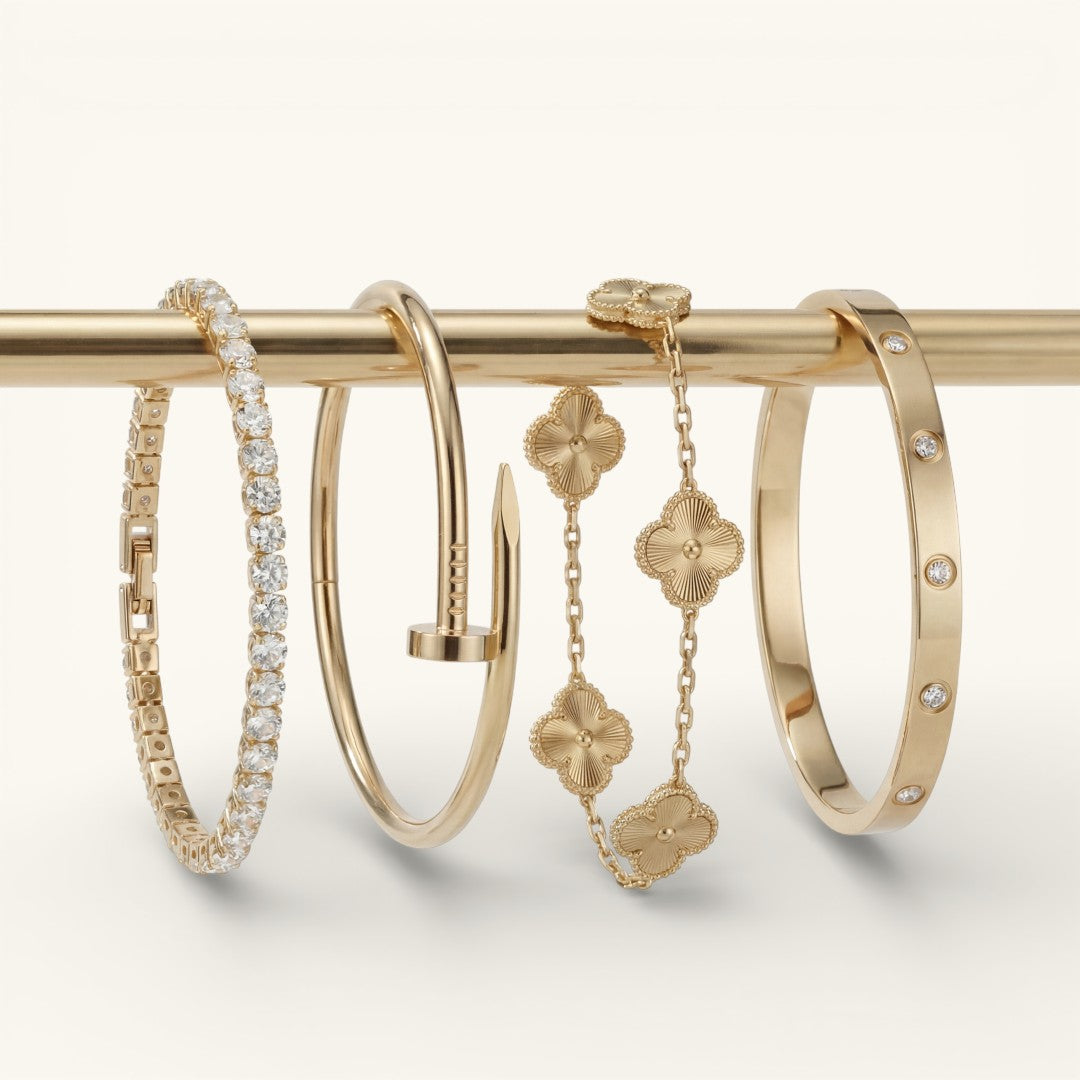
Short answer: it depends on what sits under the gold, not on the water. A thin electroplated flash will not survive daily showers. A PVD bonded finish over a surgical steel base will. Water on its own is close to harmless. What actually strips plating is soap film, hot water, and the friction of towel drying, repeated every day for months.
Why most jewelry blogs just say "take it off"
Search this question and you get the same three sentences from a dozen retailers. Do not shower in it. The gold layer is thin. The base metal will show. That advice is not wrong. It is written for the worst case, because the writer has no idea what you own.
Most jewelry sold as gold plated is a flash coat, often half a micron of gold, dropped in an electroplating bath over brass. That is about one hundredth the thickness of a sheet of paper, only mechanically stuck to the metal beneath. Wear a hole in it, get water and skin oil onto the brass, and you get the green wrist that probably started your search.
So for an unknown piece, take it off. But gold plated now covers constructions that behave nothing alike, and the blanket answer leaves you no way to tell which one is in your bathroom.
Water is not the problem. These four things are.
Clean water is nearly inert against a bonded finish. The damage comes from everything else in there.
1. Soap and shampoo residue. Body wash leaves a thin film behind. On a flat surface it dulls the shine. In the gaps between links and around stone settings it collects, dries, and goes cloudy. Most people read that cloudiness as tarnish. One commenter in r/jewelry put it plainly: "certain chemicals found in makeup, cleaners, soaps and body lotions can all cause it to happen, especially over time."
2. Hot water plus friction. Hot water does not attack metal. It softens the skin oils and soap holding grit against the surface, and then the towel does the rest. Rubbing a wet chain dry with a cotton towel is the most abrasive thing that happens to it all day.
3. Chlorine and salt. These do attack base metal, and they need only one pinhole in a coating to reach it. A pool is far harder on plated jewelry than any shower. A commenter in the same thread described the habit most people have: "I haven't always been good about removing it in chlorine pools."
4. Mechanical wear. Shampoo bottles, tile, a band grinding against the ring next to it. Coating goes at contact points first.
Three of those four have nothing to do with water.
What PVD actually does to the metal
PVD stands for physical vapor deposition, and the mechanism is the reason some pieces survive daily showers and others do not.
The steel goes into a vacuum chamber. Gold is vaporized into that vacuum and driven into the surface of the steel at a molecular level, under 72 hours of controlled heat. What comes out is not a gold layer resting on steel. The gold has migrated into the top of the steel itself, so there is no seam between the two metals.
That is the whole difference. Electroplating leaves an interface, and an interface is somewhere for water, soap, and skin oil to creep under and lift. A bonded finish has none. VM's version is the VM Triple Seal Coating over a hypoallergenic surgical steel base, which is why VM pieces are sold as waterproof and tarnish-resistant rather than as something you strip off at the bathroom door.
For how long that bond holds by piece type, see how long PVD gold plating lasts, and for the full construction comparison, gold plated vs gold filled vs vermeil vs PVD.
Shower verdict by construction
| Construction | After six months of daily showers | Verdict |
|---|---|---|
| Flash electroplate over brass | Color thins at clasps and edges, brass shows through, green marks on skin | Take it off |
| Heavier gold plate over brass | Fades more slowly, still fades, cannot be resealed at home | Take it off |
| Gold filled | Holds color well, but costs several times more per piece | Fine to wear |
| PVD bond over surgical steel | No fade from water. Any dullness is soap film that rinses off | Shower safe |
What this looks like on real pieces
Three VM bestsellers, three different shower cases.
Elegance Deluxe Stack, $49.95

Solid forms, no stones, very few gaps. This is the easiest possible shower case, because there is nowhere for residue to sit. Water runs off and it dries clear without help. It is VM's number one seller, and the set to pick if you want to stop thinking about jewelry in the bathroom. See the Elegance Deluxe Stack.
Helene Elegant Bracelet, $29.95

One continuous smooth surface and a single clasp. The clasp is the only spot worth attention, because that is where soap dries and where your fingers grip when you towel off. Rinse it, pat it, done. See the Helene Elegant Bracelet.
Tennis Bracelet Gold, $26.95

Here is where honesty is needed. The bond on the metal does not care about your shower. The stone settings do. Every claw is a tiny cup, soap film dries in those cups and scatters light, so the stones look dull while the gold looks fine. That is residue, not damage. Ten seconds under the tap fixes it. See the Tennis Bracelet Gold.
The pieces that are still the weak case
Rings need a different answer than chains do, and pretending otherwise would be useless to you.
A ring spends the whole shower in a soap sandwich. Its underside is pressed against your finger where nothing rinses, and its outer band grinds against every bottle you grab. Coating loss on rings shows up sooner than on bracelets, and always in the same place: the bottom of the band. That is friction, not a water failure, and no coating prevents it.
Chains, smooth bracelets, hoops, and pendants on a bonded steel base are genuinely fine wet.
The routine that ends the question
Rinse in plain water after a shower with a lot of product. Pat with a soft cloth rather than a bath towel, because towel loops catch on clasps. Keep it out of pools, hot tubs, and bleach. Take rings off when you scrub something.
Skeptical? Good.
A bonded gold finish over steel is not solid gold. It has no precious metal value and cannot be resold as bullion. Gouge it past the bond and steel shows, which is not a repair you can do at home. Waterproof here means fresh water, shower water, and sweat. It does not mean chlorine or a hot tub. Anyone selling you a coating that shrugs off chlorine is guessing.
What is on VM's side of the deal: a lifetime warranty on the color, so a piece that fades in normal daily wear gets replaced rather than argued about. VM holds 4.8 out of 5 on Trustpilot across more than 3,000 customers, many of them people who never take the pieces off. Those are the pieces in the bestsellers collection.
Frequently asked questions
Can you shower with gold plated jewelry every day?
Not with thin electroplated pieces over brass. Daily showers will wear through that coating within months. A PVD bonded finish over surgical steel is built for it, and the only maintenance is a plain water rinse when you have used a lot of soap or shampoo.
Does shampoo damage gold plated jewelry?
Shampoo does not corrode a bonded finish, but it leaves a film that dries cloudy in link gaps and stone settings. People mistake that haze for tarnish constantly. On flash-plated brass it is worse, because the surfactants speed up wear at points already thinning from friction.
Can I swim in a pool wearing PVD gold jewelry?
Take it off for pools and hot tubs. Chlorine attacks base metal through any microscopic gap in a coating, and the concentration in a pool is far above anything in tap water. Salt water is similar. Rinse in fresh water afterwards if you forget.
Why did my gold plated necklace turn my skin green?
The gold wore through and your skin is reacting with the brass underneath. Copper in the brass forms salts with sweat and soap, and those salts stain skin green. It cannot happen on a surgical steel base, because there is no copper in the alloy to react.
How do I clean jewelry after showering?
Rinse it under plain lukewarm water, then pat it dry with a soft cloth or a microfiber towel. Skip toothpaste, baking soda, and polishing cloths meant for silver, since all three are abrasive and will scrub a plated surface thinner every time you use them.
The verdict
If it is flash plated over brass, no, and no routine will save it. If the gold is bonded into a surgical steel base, yes, and all you owe it is a rinse.
The cheapest way to test that on your own wrist: add any two bestsellers to your cart and the lower-priced piece is free at checkout. Wear them a month without taking them off and judge the coating yourself. The Elegance Deluxe Stack at $49.95 and the Helene Elegant Bracelet at $29.95 are the two most forgiving pieces VM makes. If tarnish is the specific worry, the bracelets that hold up to daily wear are listed here.
Valerie Mason founded VM after years of replacing the same fading gold bracelets. She built the line on bonded steel so everyday jewelry could stay on in the shower, the gym, and the sea.
Buy one get one free on all bestsellers
- Waterproof 18k PVD gold
- Hypoallergenic surgical steel
- Lifetime warranty
Backed by the lifetime warranty. Nothing to lose.
Why regular gold plating is outdated
| VM | Others | |
|---|---|---|
| Waterproof, wear it in the shower | ✓ | ✗ |
| Hypoallergenic surgical steel base | ✓ | ✗ |
| Gold bonded by PVD, not layered on top | ✓ | ✗ |
| Lifetime warranty included | ✓ | ✗ |
| Every piece under $60 | ✓ | ✗ |
Ready to never overpay again?
- ✓ Buy one get one free on bestsellers
- ✓ Rated 4.8/5 by 3,000+ customers
- ✓ Lifetime warranty. No questions asked.
Lifetime warranty. No questions asked.
If a piece ever fails you, we replace it. That is the whole policy.
As seen in Vogue, Elle, Cosmopolitan, Harper's Bazaar and NYT Style