


Is PVD Coating on Jewelry Worth It? Run the Math
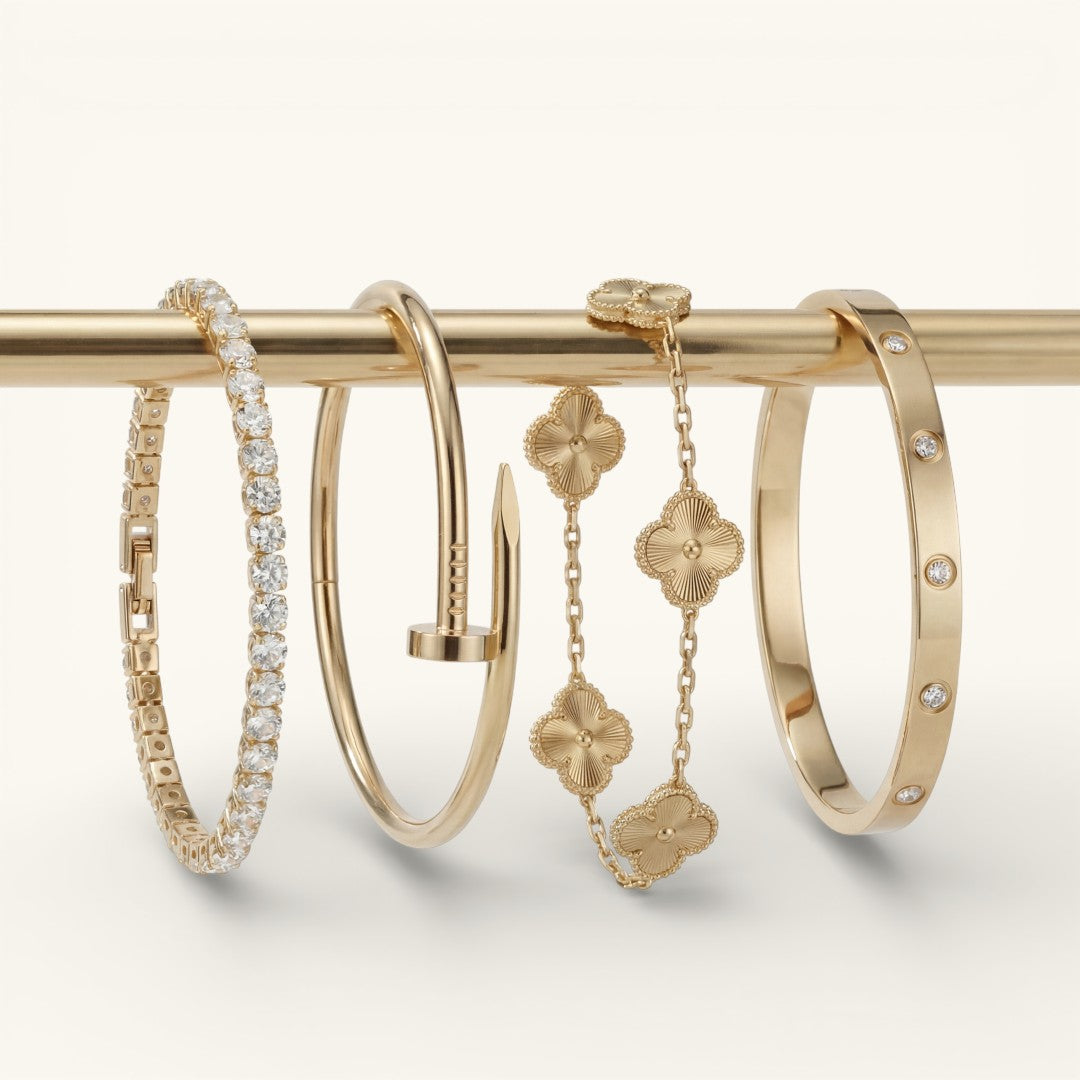
PVD coating is worth it when the piece costs you less per year of wear than whatever you would have bought instead. For a gold-look bracelet you shower in daily, that is almost always true. It stops being true the moment you need resale value, a ring you can resize, or a metal your skin has already rejected.
Every guide ranking on this question is written by somebody who sells the finish, or by somebody who sells the alternative. Both answer it as a materials question. It is not. It is a math question with two inputs nobody gives you.
What PVD actually does to the metal
Physical vapor deposition happens in a sealed chamber. Gold-toned metal is vaporized and driven into the surface of the piece under 72 hours of controlled heat, so the color ends up bonded into the top layer of the steel rather than sitting on it like paint.
That is the whole mechanism, and it is why the failure mode differs. Flash electroplate is a separate skin, so it flakes and leaves a two-tone edge. A bonded finish has nothing to lift, so when it goes it thins evenly at the friction points.
A wearer in a jewelry forum put the distinction better than most product pages do: "Plating is just an outer layer that can flake off, but PVD coating is a process that changes the color of the stainless steel."
Underneath sits a hypoallergenic surgical steel base, which is what makes the piece waterproof and tarnish-resistant. For the full category breakdown, see gold plated versus gold filled versus vermeil versus PVD.
Worth it is a math question
Here is the calculation that settles it. Take the price, divide by the years you will realistically wear the piece, and compare that number against what you would have bought otherwise, including how often you would replace it.
A $49.95 bracelet stack worn daily for three years costs about $17 a year. A $25 fashion-chain chain that dulls in a season and gets replaced every year costs $25 a year, and you spend an afternoon reordering it each time. The cheaper piece is the more expensive habit.
Run it the other way and the math turns. Against a solid gold bracelet you would keep for twenty years and could sell at the end, no coated piece wins on cost per year. It only wins on the money you are not risking in a hotel sink.
What you are actually comparing against
Prices below are typical market ranges for a gold-look bracelet, not our figures, and the last column assumes daily wear including water.
| Option | Typical price | Survives daily water | Resale value | Real cost over 3 years |
|---|---|---|---|---|
| Flash electroplate | $15 to $30 | No, peels at the edges | None | $45 to $90, replaced yearly |
| PVD bonded steel | $25 to $60 | Yes | None | $25 to $60, bought once |
| Gold filled | $60 to $150 | Mostly, wears at clasps | Very little | $60 to $150 |
| Solid 14k gold | $400 and up | Yes | Yes, scrap and resale | $400 and up, holds value |
Read the middle row honestly. PVD wins neither prestige nor resale. It wins one column, cost per year of actual wear, and for most people that is the column that decides the purchase.
Where the finish earns its money, piece by piece
The value is not equal across a jewelry box. Abrasion decides how long a bonded finish holds, so piece type matters more than brand. These three come from our bestsellers, ordered strongest case to weakest.
Elegance Deluxe Stack, $49.95

Bracelets take more contact than anything except rings, which makes this the honest test case. A stack spreads that contact across several pieces, so no single band carries the whole day. At about $17 a year over three years of daily wear, the math here is least arguable. See the stack.
Zora Diamond Necklace, $54.00

Necklaces are the easiest job a bonded finish ever gets. A chain sits against skin and fabric with almost no rubbing: no desk contact, no steering wheel, no gym bar. For the longest return on a coated piece, buy it around your neck. See the necklace.
Elegance Deluxe Ring, $19.95

Rings are the weak case and we say so. The underside of a band grinds against everything you pick up, so color goes there first, and our own wear timeline by piece type puts rings at the short end of the range. At $19.95 the math still works. At $80 it would not. See the ring.
Three times PVD is not worth it
First, when you want the metal to hold value. A jeweler in a forum thread on stainless steel named the drawback in four words: "it has no melt value." Coated steel is worth nothing at a scrap counter and nothing on resale. If the purchase is meant to store money, buy gold.
Second, when the ring has to be resized. A bonded finish cannot be cut, stretched, and refinished the way solid metal can. Buy your size or buy adjustable.
Third, when your skin has already refused steel. Surgical steel is hypoallergenic and it is why most people stop reacting, but it is not nickel-free, and a minority genuinely cannot wear it. As one commenter with multiple cartilage piercings wrote: "I absolutely can NOT wear stainless steel." No coating fixes that, and we would rather you knew before ordering. Still diagnosing? We covered the two separate causes behind skin turning green.
What daily wearers actually say
The people happiest with coated steel are not buying it as a substitute for fine jewelry. They buy it for the situations where fine jewelry is a liability.
One wearer described the appeal as pure risk removal: "I often pack it with me when I travel or wear it when I go out to a club or a show because I know I wouldn't be heartbroken if I lost it." Another was blunter: "I'm also too lazy to take my necklace off when I shower or swim, and don't want to ruin my expensive pieces."
Calibrate your expectations on the look. The same forum regular who explained the bonding process also noted the color: "Stainless Steel PVD is not as bright yellow as 18-24k gold. However, it can totally pass for a more alloyed gold like 10k." That is accurate, and most people prefer the quieter tone anyway.
Skeptical? Good.
You should be, because the category is full of sellers calling flash electroplate "PVD" and hoping nobody checks. Here is our fine print in plain language.
The color is bonded into the steel over 72 hours of controlled heat and sealed with our VM Triple Seal Coating. It is waterproof and tarnish-resistant, so showers, pools, and workouts are fine. It is not solid gold, it carries no resale value, and it cannot be refinished once worn through. Rings wear fastest, necklaces slowest.
Every piece carries a lifetime warranty, so if the color goes, you are not buying it again. You test whether the finish holds, and we pay if it does not.
If you want two pieces for the price of one while you decide, add any two bestsellers and the lower-priced piece is free at checkout.
Frequently asked questions
Is PVD coating better than gold plating?
For durability, yes. Gold plating is a separate layer that can flake and peel at the edges. PVD bonds the color into the surface of the steel, so it thins gradually at friction points instead of chipping. Neither one is solid gold, and neither carries resale value.
How long does PVD jewelry actually last?
It depends far more on the piece type than the brand. Necklaces last longest because nothing rubs them. Bracelets sit in the middle. Rings are shortest because the underside of the band abrades against everything you touch. Our wear timeline breaks this down by piece.
Can I shower and swim in PVD coated jewelry?
Yes. The steel base is waterproof and the bonded finish does not lift in water. Chlorine and salt are fine for normal exposure. The one habit worth changing is drying the piece after, because soap film dulls the shine long before the color ever moves. We went deeper on showering with gold plated jewelry.
Is PVD jewelry safe for sensitive skin?
For most people, yes. The base is hypoallergenic surgical steel and the bonded finish contains no copper, which is what turns skin green on cheap alloys. Surgical steel is not nickel-free though, so a confirmed nickel allergy is the one case we cannot promise to solve.
Is PVD coated jewelry worth it as a gift?
It is a strong gift precisely because it needs no care instructions. The recipient cannot ruin it in the shower, does not have to remember to take it off, and does not have to insure it. What it will not do is serve as an heirloom.
The verdict
PVD coating is worth it if you want gold-look jewelry you never take off, priced so the loss of it would annoy you rather than wreck you. Divide the price by three years and compare. If that number beats your current replacement habit, the answer is yes.
It is not worth it if you need melt value, a resizable band, or a metal your skin has ruled out. We would rather say that plainly than sell you a piece that goes in a drawer.
Start with the necklace for maximum life, the stack for daily wear, or compare the rest of the bestsellers. Still deciding on the base metal? Read our honest take on whether stainless steel jewelry is good.
About VM
VM builds waterproof gold-look jewelry for women who would rather wear their pieces than protect them. The brand holds a 4.8 out of 5 rating on Trustpilot and ships to more than 3,000 customers who wanted jewelry that survives a normal life. Valerie Mason founded VM after getting tired of taking her jewelry off.
Buy one get one free on all bestsellers
- Waterproof 18k PVD gold
- Hypoallergenic surgical steel
- Lifetime warranty
Backed by the lifetime warranty. Nothing to lose.
Why regular gold plating is outdated
| VM | Others | |
|---|---|---|
| Waterproof, wear it in the shower | ✓ | ✗ |
| Hypoallergenic surgical steel base | ✓ | ✗ |
| Gold bonded by PVD, not layered on top | ✓ | ✗ |
| Lifetime warranty included | ✓ | ✗ |
| Every piece under $60 | ✓ | ✗ |
Ready to never overpay again?
- ✓ Buy one get one free on bestsellers
- ✓ Rated 4.8/5 by 3,000+ customers
- ✓ Lifetime warranty. No questions asked.
Lifetime warranty. No questions asked.
If a piece ever fails you, we replace it. That is the whole policy.
As seen in Vogue, Elle, Cosmopolitan, Harper's Bazaar and NYT Style